
Knowing what weighs 100 grams can make everyday measurements much easier. Whether you are cooking, comparing household objects, measuring small packages, or looking for a reference weight without a kitchen scale, familiar items can help you understand this measurement.
One hundred grams is a relatively light amount of weight, equal to 0.1 kilograms or approximately 3.53 ounces. Although it may not sound like much, several common objects weigh close to this amount.
The interesting part is that these objects come in different shapes, sizes, and materials. A chocolate bar, a newborn kitten, a stack of paper, and a group of coins can all provide useful examples of what 100 grams looks like.
Let’s explore 15 everyday items that weigh approximately 100 grams and learn how to estimate this weight without using a scale.
What Weighs 100 Grams: Daily Use Items That Weigh 100 Grams
| No. | Daily Use Item | Approximate Weight |
| 1 | Small Apple | 100 grams |
| 2 | Medium-Sized Tomato | 100 grams |
| 3 | Bar of Soap | 100 grams |
| 4 | Small Chocolate Bar | 100 grams |
| 5 | Tennis Ball (2–3 balls) | 100 grams |
| 6 | Small Pack of Biscuits | 100 grams |
| 7 | Half Cup of Rice | 100 grams |
| 8 | Small Potato | 100 grams |
| 9 | 100 Paper Clips (approximately) | 100 grams |
| 10 | Small Lemon | 100 grams |
| 11 | Deck of Playing Cards | 100 grams |
| 12 | Small Pack of Nuts | 100 grams |
| 13 | Four Large Eggs (without shells, approximately) | 100 grams |
| 14 | Small Candle | 100 grams |
| 15 | A Small Handful of Almonds | 100 grams |
Finding objects that weigh 100 grams is easier than you might expect. Many household products, grocery items, and everyday accessories provide convenient weight comparisons.
Some examples below weigh exactly 100 grams when they meet a particular standard, while others are approximate because their sizes and materials vary.
1. A New Bar of Dove Soap

A standard 100-gram bar of Dove soap is an easy household reference. Its packaging often displays the weight, making it convenient for understanding this measurement.
The bar is compact enough to fit comfortably in your hand, yet it provides a useful example of how much 100 grams feels like.
However, Dove soap comes in different sizes depending on the country and product range. Always check the packaging to confirm that you have a 100-gram bar.
2. A Standard Chocolate Bar

A 100-gram chocolate bar is one of the easiest ways to visualize this weight. Many popular chocolate brands sell bars in this size, making them a familiar grocery-store reference.
Whether you prefer milk chocolate, dark chocolate, or white chocolate, a bar labeled 100 grams provides the same net weight.
Chocolate is also a useful comparison because it demonstrates that a relatively small object can have a noticeable weight.
Quick fact: A 100-gram chocolate bar weighs approximately 3.53 ounces.
3. Two Medium Chicken Eggs

Two medium chicken eggs can provide a close comparison to 100 grams. A typical medium egg weighs around 50 grams with its shell, although actual weights vary.
Together, two eggs can approach 100 grams, making them a convenient kitchen reference.
The edible portion weighs less because the shell contributes to the total weight. Therefore, if you are measuring ingredients for a recipe, remember to distinguish between whole eggs and their contents.
4. A Deck of Playing Cards

A standard deck of 52 playing cards can weigh close to 100 grams, depending on the card material, finish, and packaging.
Some decks weigh considerably less, while premium playing cards with thicker stock and packaging may approach or exceed this measurement.
A deck is particularly useful as a visual reference because it is compact, portable, and commonly found in households.
If you want an accurate comparison, weigh the complete deck rather than assuming every brand has the same weight.
5. A Victorinox Pocket Knife

A Victorinox pocket knife can be a useful example of a small, relatively heavy everyday object.
However, its weight depends heavily on the model. Smaller Swiss Army knives may weigh around 20 to 60 grams, while larger models with additional tools can weigh considerably more than 100 grams.
A medium-sized model may approach the 100-gram range, but not every Victorinox pocket knife weighs this amount.
This example highlights how metal components can make a compact object surprisingly heavy.
6. 20 Sheets of A4 Printer Paper

Twenty sheets of standard A4 printer paper can weigh approximately 100 grams when the paper has an 80 GSM specification.
GSM stands for grams per square meter. It describes the weight of paper based on its area rather than the weight of an individual sheet.
A standard A4 sheet has an area of approximately 0.0624 square meters. At 80 GSM, each sheet weighs about five grams.
That means:
- One A4 sheet weighs approximately 5 grams.
- Ten sheets weigh approximately 50 grams.
- Twenty sheets weigh approximately 100 grams.
This is an excellent example for students, office workers, and anyone who regularly handles printer paper.
7. 100 Standard Paperclips
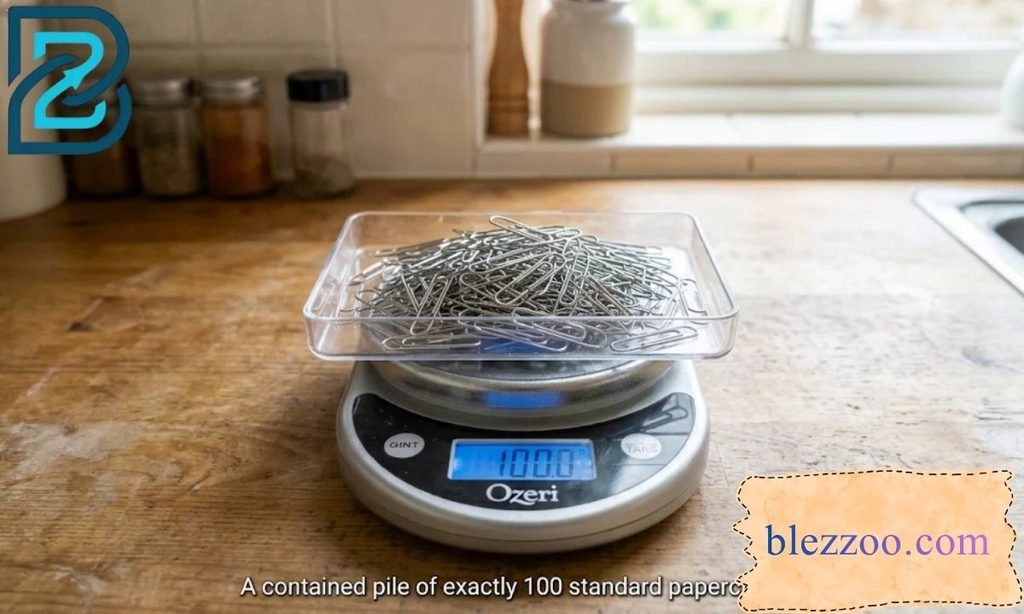
Paperclips are small, lightweight office supplies, but collecting many of them can create a useful weight comparison.
However, 100 standard small paperclips do not necessarily weigh 100 grams. A typical small paperclip may weigh around 0.4 to 0.5 grams, meaning 100 could weigh approximately 40 to 50 grams.
Larger and heavier paperclips may weigh more.
To reach approximately 100 grams, you may need around 200 to 250 small paperclips, depending on their material and dimensions.
This example shows why counting objects alone cannot guarantee an accurate weight.
8. Half a Cup of Granulated White Sugar

Half a US cup of granulated white sugar weighs approximately 100 grams. This makes it one of the most practical examples for anyone who enjoys baking or preparing desserts.
Unlike water, sugar has a different density, so its volume and weight do not match directly.
For a useful kitchen reference, remember:
- One US cup of granulated sugar weighs approximately 200 grams.
- Half a cup weighs approximately 100 grams.
- One-quarter cup weighs approximately 50 grams.
These measurements are approximate because the way sugar settles inside a measuring cup can slightly affect the result.
9. Five Slices of White Sandwich Bread

Five slices of white sandwich bread can provide a reasonable comparison to 100 grams, depending on their thickness and size.
A typical slice may weigh around 20 grams, although some brands produce thinner or thicker slices.
When five slices weigh approximately 20 grams each, their combined weight reaches 100 grams.
This makes sandwich bread a convenient household reference, especially when you want to estimate small food portions without using a scale.
10. A Large Kiwifruit
A large kiwifruit can weigh approximately 100 grams, although smaller varieties may weigh considerably less.
Its weight depends on the fruit’s variety, maturity, and size. A large kiwi with its fuzzy brown skin can approach this measurement.
Kiwifruit is a useful example because it demonstrates that natural foods rarely have perfectly consistent weights.
If you are tracking ingredients or preparing fruit portions, using 100 grams as an approximate reference is more reliable than assuming every kiwi weighs the same.
11. A Small Bag of Ground Spices

A small 100-gram bag of ground spices is another practical example. Grocery stores commonly sell turmeric, cumin, chili powder, coriander, and other seasonings in different package sizes.
A sealed bag labeled 100 grams contains that amount of spice by net weight, excluding the packaging.
Ground spices can look like a small quantity because their volume depends on their density and texture.
For example, 100 grams of ground cinnamon may occupy a different amount of space than 100 grams of turmeric powder.
This makes packaged spices a helpful reference for understanding the difference between volume and weight.
12. A Stack of 100 U.S. Dollar Bills

Here is an interesting example involving money. A standard US banknote weighs approximately one gram, regardless of its denomination.
Therefore, a stack of 100 genuine US dollar bills weighs approximately 100 grams.
The total monetary value depends on the denomination of the notes:
- 100 one-dollar bills equal $100.
- 100 five-dollar bills equal $500.
- 100 twenty-dollar bills equal $2,000.
- 100 hundred-dollar bills equal $10,000.
This is a fascinating comparison because a relatively small stack of paper money can provide a practical 100-gram reference.
Read more information on : What Weighs 1 Pound
13. A Newborn Kitten

A newborn kitten often weighs around 85 to 115 grams at birth, making 100 grams a useful example of its approximate size.
Its weight can vary depending on breed, litter size, maternal health, and individual development.
Kittens are extremely small during their first days of life, so even a small change in weight can be important.
For animal care, monitoring a newborn kitten’s weight regularly helps identify whether it is growing properly.
This example also reminds us that 100 grams can represent a significant amount of body weight for a very young animal.
14. A Small Decorative Candle

A small decorative candle can weigh approximately 100 grams, depending on its dimensions and the type of wax used.
Candles made from paraffin, soy wax, or beeswax can have different densities and weights.
A compact pillar candle or small decorative candle may approach this measurement, but its weight is not standardized.
If you need a candle as a weight reference, look for packaging that specifies 100 grams or measure it using a scale.
15. 20 UK 20-Pence Coins

UK 20-pence coins offer one of the most accurate examples on this list. A standard modern 20-pence coin weighs exactly five grams.
Therefore, 20 coins have a combined weight of 100 grams.
The calculation is simple:
- One 20p coin = 5 grams.
- Five coins = 25 grams.
- Ten coins = 50 grams.
- Twenty coins = 100 grams.
This makes British 20-pence coins an excellent reference for understanding 100 grams. Just ensure you are using standard circulating coins rather than unusual commemorative versions.
How to Estimate 100 Grams Without a Scale
You do not always need a digital kitchen scale to estimate 100 grams. Several everyday objects and simple measurement techniques can help you get reasonably close to this weight.
Here are some practical methods you can try at home.
Use a Familiar Reference Object
Choose an object with a clearly labeled weight, such as a 100-gram chocolate bar or soap package. Hold another item in your hand and compare their weights.
This method is useful when you need a quick estimate rather than an exact measurement.
Use Water as a Measuring Reference
Water provides one of the easiest ways to estimate 100 grams because one milliliter of water weighs approximately one gram.
- 50 ml of water = 50 grams.
- 100 ml of water = 100 grams.
- 150 ml of water = 150 grams.
- 200 ml of water = 200 grams.
You can use a measuring jug to measure 100 ml of water and create a simple weight reference.
Compare Coins
If you have UK 20-pence coins, you can use them as a convenient reference.
Each standard coin weighs five grams, so 20 coins provide approximately 100 grams.
Use Printer Paper
Standard 80 GSM A4 paper provides another useful comparison.
- Five sheets = Approximately 25 grams.
- Ten sheets = Approximately 50 grams.
- Twenty sheets = Approximately 100 grams.
Compare Food Portions
Some common kitchen ingredients can help you estimate 100 grams without special equipment.
A half cup of granulated sugar, for example, weighs approximately 100 grams. You can use this measurement when preparing recipes or estimating food portions.
100 Grams in Common Cooking Conversions
Understanding how 100 grams translates into common kitchen measurements can make cooking and baking easier. However, remember that grams measure weight, while cups and tablespoons measure volume.
Different ingredients have different densities, so 100 grams of flour will not occupy the same space as 100 grams of sugar.
The following table provides practical kitchen conversions.
| Ingredient | Approximate Measurement for 100g |
| Water | 100 ml |
| Granulated sugar | ½ US cup |
| All-purpose flour | About ⅚ US cup |
| Butter | About 7 tablespoons |
| Uncooked white rice | About ½ US cup |
| Rolled oats | About 1¼ US cups |
| Honey | About 5 tablespoons |
| Milk | About 97 ml |
These measurements are approximate and can vary depending on the ingredient, packing method, and measuring technique.
Why Grams Are Better for Accurate Baking
Using grams instead of cups can improve consistency when preparing recipes. A measuring cup filled with flour can contain different amounts depending on whether the flour is sifted, scooped, or packed.
A digital kitchen scale provides more consistent results because it measures the actual mass of an ingredient.
For better baking accuracy:
- Measure dry ingredients by weight whenever possible.
- Avoid packing flour into measuring cups.
- Zero the scale before adding each ingredient.
- Follow the recipe’s specified units.
- Use a reliable kitchen scale for precise measurements.
What About Calibrating a Scale With 100 Grams?
A 100-gram reference weight can be useful when checking whether a digital scale is measuring correctly. If you regularly use a kitchen scale for cooking, baking, or small packages, checking its accuracy can help prevent measurement mistakes.
However, not every object that weighs approximately 100 grams is suitable for precise calibration.
Use a Proper Calibration Weight
The most reliable option is a certified 100-gram calibration weight designed for weighing scales.
These weights are manufactured to meet specific accuracy standards and provide a dependable reference.
Prepare Your Scale
Before checking the measurement, follow these simple steps:
- Place your scale on a flat, stable surface.
- Make sure the weighing platform is clean.
- Turn on the scale and allow it to reset.
- Select the appropriate weighing unit.
- Follow the manufacturer’s calibration instructions.
Test the 100-Gram Measurement
Place the calibration weight gently in the center of the weighing platform.
The display should read 100 grams within the scale’s specified tolerance. If the reading is incorrect, follow the manufacturer’s instructions to calibrate or adjust the scale.
Can Everyday Objects Calibrate a Scale?
Some familiar objects can help check a scale, but they are not necessarily accurate enough for calibration.
For example:
- A 100-gram chocolate bar may have slight packaging or manufacturing variations.
- Twenty UK 20-pence coins have a nominal combined weight of 100 grams, but wear and dirt can affect their actual weight.
- A stack of banknotes provides only an approximate reference.
Important: Use certified calibration weights when accuracy matters, especially for scientific, commercial, or laboratory measurements.
FAQs
What household item weighs exactly 100 grams?
Twenty standard UK 20-pence coins have a combined nominal weight of 100 grams.
Is 100 grams equal to 3.5 ounces?
Yes, 100 grams is approximately 3.53 ounces.
How many kilograms are in 100 grams?
100 grams equals 0.1 kilograms.
Can two eggs weigh 100 grams?
Yes, two medium eggs with their shells can weigh approximately 100 grams.
How much is 100 grams of water?
100 grams of water equals approximately 100 milliliters.
Final Words
Understanding what weighs 100 grams becomes much easier when you compare this measurement with familiar household objects. Everyday items such as chocolate bars, soap, printer paper, eggs, coins, and small decorative candles can help you develop a better sense of this weight.
Remember these useful measurements:
- 100 grams = 0.1 kilograms.
- 100 grams = Approximately 3.53 ounces.
- 100 grams = 100,000 milligrams.
- 100 grams of water = Approximately 100 milliliters.
- Twenty standard UK 20-pence coins = 100 grams.
The next time you need to estimate 100 grams without a scale, use one of these everyday references. For cooking, baking, or accurate measurements, a digital kitchen scale remains the most dependable option.
Read more information on :






1 thought on “What weighs 100 grams? 15 Surprising Everyday Items to Know”